A culvert is a pipe that allows water to flow under streets and roads. Most of Oregon’s transportation infrastructure was built between the 1950’s-1970’s, and many culverts have not been replaced since. Over time, culverts rust-out and fill with holes. Heavier-than-normal trucks cause structural damage and even crush these pipes. Sometimes the earth below the culvert erodes away so water flows beneath it, inspiring questions about the structural integrity of the road itself.
The culverts under Agaard Road, tucked in the coast range off Highway 6, showed all three examples of culvert failure. They also showed us an opportunity.

Culvert creates safety issue for the residents along Agaard Road
Over the years, one particular culvert has caused its fair share of headaches for the residents on Agaard Road.
Coffee Creek flows through this culvert on its way to join Gales Creek just two dozen feet downstream. The outdated culvert was too small for the creek’s high winter flow. During heavy winter rains, the culvert would clog. This would cause the creek level to rise and flood the road with swift moving water. This made travel on Agaard Road perilous for the 40 or so neighbors that rely on the road to get in and out of the neighborhood.
This flooding caused erosion, creating ruts and potholes along the road. Even more alarming, the stream was carving away the streambank, causing the road to get narrower and narrower.

The hidden impacts on endangeredEndangered A species or group at serious risk of no longer existing. It is also a legal term under the U.S. Endangered Species Act. fish populations
Culverts like this, and two others in the area, created challenges for the fish and wildlife, too. The Gales Creek community is home to some of the best fish habitat in all of Washington County. In 2013, a fish survey throughout the Gales Creek subbasin found that “The largest numbers of steelhead in the Sub-Basin were observed above the confluence with Coffee Creek” (page 33).
However, outdated, damaged culverts create serious problems for fish. These culverts also cut off important habitat areas upstream from migrating salmon and steelhead downstream.

For example, Adult fish downstream of the culvert could not return to their historic spawning grounds. In spring and fall, the force of the water flowing through the culvert was too high, and the culvert was too small.

The culvert caused problems in the summer time, too. When the weather is hot, fish search for cold water as refuge from warmer waters in the creek or river. Sometimes areas of the Tualatin can reach lethal water temperatures for migrating salmon and other aquatic critters! Small juvenile fish seeking cold water refuge could not jump up into the culvert to swim upstream to the miles of cool stream waters above. When juvenile fish needed it most, they had to turn around and find another place along Gales Creek to rest and stay cool.

Identifying this culvert as the culprit
In 2015, Tualatin River Watershed Council (TRWC) identified the Coffee Creek culverts as a priority to remove. They had two goals. First, replace the culverts with bridges. This would reconnect over 17 stream miles of prime fish habitat with the rest of the Tualatin River watershed downstream. Second, plant native plants along the streambanks. This would provide shade on these streams and protect water quality from erosion and sediment or agricultural runoff.
With support of neighbors along Agaard Road, TRWC teamed up with Tualatin Soil and Water Conservation District (Tualatin SWCD) USDA Natural Resource Conservation Service (NRCS) and Clean Water Services to remove the culverts and replace them with bridges.


Culvert replacement: what it takes
Replacing a culvert is a huge project. First, to keep the residential area connected to the highway, a temporary bridge was built, and the electricity and internet cables were re-routed out of the project area. Then, earth over the culvert was then torn out and the damaged culvert was removed. Next, the foundation for the new bridge was poured. While that was drying, a habitat restoration crew worked upstream, reshaping the banks of Coffee Creek, installing habitat structures out of large woody debris, and planting native shrubs to prevent future erosion.
Once the bridge foundation cured, the bridge was constructed! The temporary bridge was deconstructed, and the power lines were moved back to a permanent location. The project was completed in fall 2025.

An excavator lifts one of the outdated culverts out from the creek bed. August 2025. 
Pouring the foundation for the bridge. 
Upstream of the bridge: Reshaping and replanting the stream banks of Coffee Creek. The intricate shape of these root wads will cause fast moving water to slow down, decreasing the likelihood of erosion. They also create shade and hiding places for small fish and other aquatic critters. 
The logs were layered with soil, strawbales, and burlap fabric to keep the soil in place. 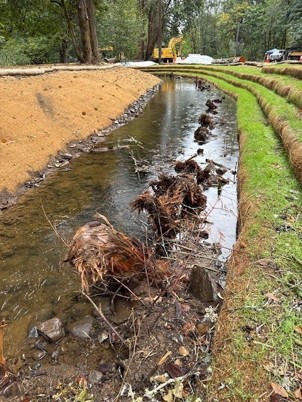
The finished result: over the root wads, strawbale steps with grass growing through the burlap creating structure for Coffee Creek.
The before and after


The future is clear: more fish, less flooding
In December 2025, the region experienced heavy rain. However, the road did not flood and the streambank remained intact.

Less than six months after the project was finished, Tualatin SWCD Habitat Conservation Specialist Olivia Hurd saw a steelhead migrating upstream of the old culvert site. Migratory fish populations downstream of the culvert had not been able to swim up here for decades!
From 2025-2030, Tualatin SWCD has committed to continue taking care of the project site by continuing to plant native plants, monitor plant growth and fish populations, and stay in touch with Agaard Road residents.
This project would not have been possible without the patience and cooperation of local residents.
For more information on the project, read the NRCS story.
The project is funded in part by the USDA NRCS Regional Conservation Partnership Program, ODFW’s Private Forest Accord Grant Program, Tualatin Soil and Water Conservation District, and Clean Water Services.