

The 2020 Labor Day fires marked my first encounter with wildfire.
I arrived in Oregon from the East Coast in January and spent most of the COVID-19 pandemic exploring the region’s beautiful and diverse landscapes. On the fateful Monday, September 7th, I was hiking the Clackamas Riverside Trail, admiring majestic groves of old-growth, and noting the inviting dispersed campsites I happened upon. Unexpectedly, the weather turned ominous, and my instincts told me it was time to head back.

My view of the Clackamas River as I hiked back to my car on Labor Day, 2020. The trail remains closed. Photo by Annie Bronez. 
The Rainbow Campground along the Clackamas Riverside Trail was severely damaged. Photo by USFS. 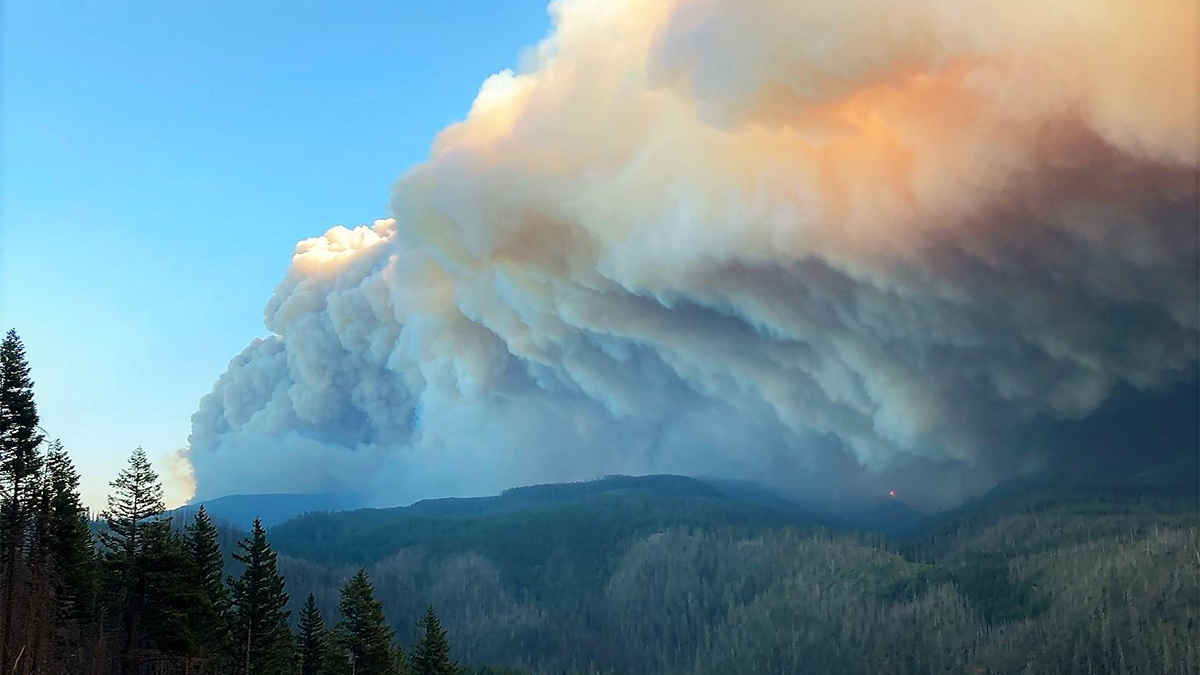
Billows of smoke rise as the Riverside Fire consumes the Clackamas River scenic corridor. Photo by USFS. 
The area experienced Oregon’s worst air quality ever recorded. Some neighborhoods surpassed the AQI’s upper threshold for hazardous air, 500. Photo by Annie Bronez. 
The Clackamas River corridor after the Riverside fire had been extinguished. Photo by USFS.
I retraced my steps to an exposed section of trail, where dead standing trees outnumbered living ones. The wind was fierce, ripping branches from hollow trunks and sending them flying. I yelped as I ducked and covered my head to avoid nearly being hit.
When I reached my car, I noticed the sky had turned dark and a new smell filled the air. As I drove down Highway 224 towards Portland, flickering embers caught my eye. Like the first snowflakes of a winter storm, the glowing specks haphazardly appeared and disappeared. Gradually, the embers became more consistent. They floated over my car from behind, landing on the grassy median where they ignited into flames. “So, this is what it’s like living in the West, I guess,” I thought to my naïve self.
People assured me the 2020 Labor Day fires weren’t the norm.
That no, we do not typically suffer the worst air quality in the world for days on end. And no, we do not usually duct tape our windows shut to keep the toxic smoke out.
Normally, areas west of the Cascades tend to be well hydrated by moist air currents flowing in from the Pacific Ocean. But that holiday weekend, strong, hot, dry winds blew from the east rather than the usual cool ocean air. On the heels of a super-heated summer, the east winds combined with a thirsty landscape, creating conditions known as extreme fire weather. As a result, western Oregon experienced seventeen wildfires, five of them megafires, collectively burning over one million acres of forest.
While the weather conditions and fire intensity on Labor Day 2020 were unusual, wildfire in the Willamette Valley and Coast Range is not.
For tens of thousands of years, the land now referred to as Washington County didn’t just experience fire routinely, it thrived with fire. It’s our relationship to wildfire that has drastically changed in just 100 years.
A brief history of wildfire in NW Oregon.
The diversity of landscapes our region is blessed with brings a variety of fire behavior. Wildfire in one ecoregionEcoregion A large geographical area containing similar ecosystems. For example, the Coast Range will look and affect the land differently than wildfire in another, even nearby, ecoregion.
For most of its existence, the Willamette Valley looked vastly different than it does today.
Cities and farms aside, the original plant communities would be unrecognizable to many people today. Douglas-fir reigns supreme now, but before white settlers arrived it was Oregon white oak that characterized the region.
The Kalapuya and other Indigenous people carefully stewarded this land with controlled burning to promote a healthy, balanced ecosystem. The routine, low-intensity burns cleared shrubs and fire-intolerant saplings but left behind the hardy, fire-resistant Oregon white oak. The resulting landscape was a patchwork of expansive prairie, lone oaks, and clusters of oak mixed with other trees like Willamette Valley ponderosa pine and madrone.
Wildfire in the Coast Range was the opposite of the regularly burned Willamette Valley.
Before the timber industry took root, the Coast Range forests were a diverse mosaic of habitats. Mixed oak woodlandsOak Woodlands A mix of oak trees and shrubs. in the foothills led to stands of Douglas fir, spruce, and hemlock in higher, moister elevations.
Frequent natural disturbance, such as windstorms and lightning-caused fire, affected forest progression sporadically. Resulting in a patchwork of open meadows and tree stands of various ages and species composition. About every 200 to 400 years, conditions would align just so, allowing a wildfire to roar through these forests in a catastrophic, stand-replacing event. Such an occurrence would reset the ecological clock and from the ashes would grow a new forest.

Historical photos from a fire tower on Round Top Mountain help us understand what our area looked like before western settlement. Photo by USFS Archives in partnership with the Nature Conservancy. 
Historical photos from a fire tower on Round Top Mountain help us understand what our area looked like before western settlement. Photo by USFS Archives in partnership with the Nature Conservancy. 
Historical photos from a fire tower on Round Top Mountain help us understand what our area looked like before western settlement. Photo by USFS Archives in partnership with the Nature Conservancy. 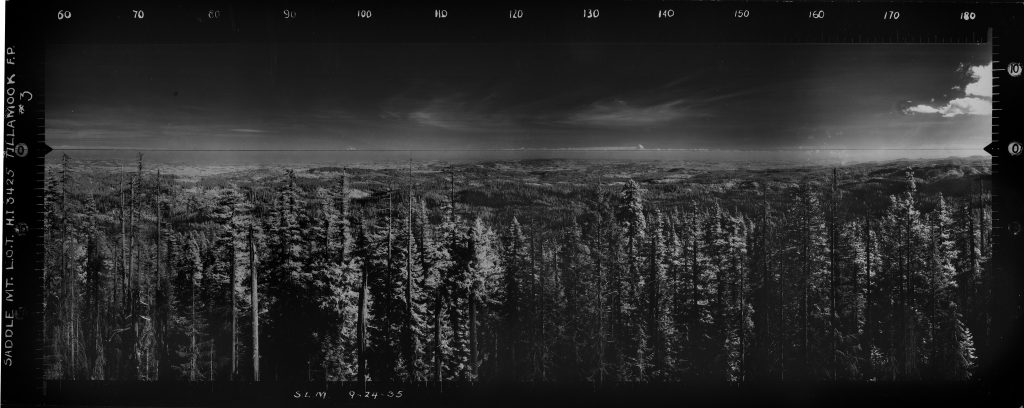
Historical photos from a fire tower on Saddle Mountain help us understand what our area looked like before western settlement. Photo by USFS Archives in partnership with the Nature Conservancy. 
Historical photos from a fire tower on Saddle Mountain help us understand what our area looked like before western settlement. Photo by USFS Archives in partnership with the Nature Conservancy.
The tribal collapse from disease and expulsion of the Native peoples by western settlers in 1855 marked the beginning of a new fire regime.
Initially, settlers used fire to clear land for agriculture. But by the early 1900s, fire suppression was formally adopted to protect profitable timberland and railroad infrastructure.
The Oregon Department of Forestry (ODF) was created in 1911 and by the 1930s, forest protective associations (FPAs) had formed throughout the state to suppress wildfire. Composed of industrial and non-industrial forest owners, FPAs provide fire-fighting response in coordination with ODF and other agencies.
Prioritization of timber growing and fire suppression throughout the twentieth century contributed to the rapid transition from variable and oak-dominated ecosystems to the dense, conifer forests we associate with northwest Oregon today.
Large Wildfires of Washington County.
While local fire suppression efforts have been highly effective, Washington County has experienced its share of large wildfires.
See the graphic below for a summary of notable fires between 1932 and 2020. Of these 11 fires, five (and some of the largest) are associated with extreme fire weather.

Throughout the fall of 1932, five separate fires destroyed timberlands, logging equipment, and railroads across Washington, Clatsop, Tillamook, and Columbia Counties. On September 27th, 1932, extreme fire weather set in. The largest of the five fires, the Cochran Fire [1], occurred when a slash fire escaped and burned the small mill towns of Cochran and Enright. Southern Pacific rail service was suspended for a month to repair severely damaged tunnels.
The 1933 Tillamook Burn and 1939 Dutch Canyon Fire are associated with similar weather conditions. The most recent Washington County wildfires associated with extreme fire weather are the Powerline Fire and the Chehalem Mountain-Bald Peak fire – both of which ignited on Labor Day of 2020.
Wildfire Risk in Washington County.

A fire “whirl” is caused by extreme heat. Photo by Taylor Johnson, ODF 
Invasive weeds such as Himalayan blackberry are highly flammable. Photo by Taylor Johnson, ODF. 
Strong winds blowing embers can spread fire rapidly. Photo by Gaston Fire District. 
Several active fires including the Powerline Fire over Labor Day weekend 2020 caused poor air quality in Washington County. Photo by Gaston Fire District. 
Post burn, Powerline Fire 2020. Photo by Gaston Fire District. 
A fire fighter fights works to extinguish a burning steep slope. Photo by Taylor Johnson, ODF. 
A fire fighter fights the Game Hog Creek Fire, 2021. Photo by Taylor Johnson, ODF 
The Game Hog Creek fire of 2021. Photo by Taylor Johnson, ODF
Wildfire risk assessments:
A wildfire risk assessment is a tool that helps inform how likely a wildfire is to occur and what that wildfire could look like. Computers analyze factors such as topography, weather patterns, and vegetation to predict a wildfire’s behavior and impacts.
These models are most useful for answering specific questions such as: Which communities are most at risk of being damaged by a wildfire? Or where will mitigation efforts have the greatest influence?
This information is used by municipalities and land management agencies to focus wildfire preparedness efforts. In Oregon, there have been several state-wide wildfire assessments completed by ODF and OSU. Local partners in Washington County have also completed an assessment specifically for the Tualatin River watershed.
Wildfire risk in Washington County is low to moderate relative to the rest of Oregon and Washington. The top concern for our communities is preparing for extreme fire weather.
Although the annual burn probability in Washington County is low, all lands are vulnerable to fire under the right conditions. Extreme fire weather includes high temperatures and dry east winds, often associated with months of preceding drought. This weather pattern favors fast moving, high intensity fires that are challenging to contain and may require rain or snow to fully extinguish.
Our rapidly changing climate increases the likelihood of extreme fire weather, contributing to severe, high intensity wildfires. It is imperative that residents take care to prevent starting a fire and to prepare their families, homes, and forests for wildfire.
Increasing Local Wildfire Resiliency.
Washington County residents can best prepare for fire by fostering resilient landscapes and building fire-adapted communities.
Healthy forests are resilient forests.
Many management actions that prepare a timberland for wildfire are often good for forest and ecosystem health too. Invasive species, tightly stocked woodlands, and overall poor stand health elevate wildfire risk. Proactive weed treatment, stand thinning, slash management, and ladder fuelFuel Human-built structures and plant material that can burn during a wildfire. reduction are some tactics that can protect your forest from the devastating effects of wildfire.

In addition to mechanical and chemical treatments on the land, introducing prescribed fire (when and where appropriate) can be effective at increasing landscape-scale resilience. Examples of controlled burns include recent activities at the Tualatin River National Wildlife Refuge. It’s essential that prescribed fire is planned and implemented by a team of experienced firefighters and practitioners.
Communities must work together to prevent and prepare for wildfire.
Residents must work together to avoid starting fires, prepare homes and community infrastructure for fire, and coordinate an effective evacuation plan. People account for roughly 90% of wildfire ignitions in Washington County and the population has nearly tripled in just fifty years. As urban communities expand into rural areas, there is greater potential for human-caused ignitions.
Homes with defensible space and routinely managed vegetation are more likely to withstand a wildfire. Maintaining clear access to a property allows firefighters to reach and protect structures more easily. And most importantly, having an evacuation plan and preparing ahead can protect people, pets, and livestock in the event a fire.
Acknowledgements:
This article was written with assistance from Aaron Groth, OSU Extension Fire Specialist, Jen Warren, Fire Risk Reduction Specialist, and Brandy Saffell, Forest Conservation Program Specialist.
It was adapted from Washington County’s Fire History: Landscapes of the Willamette Valley and Coast Range by Aaron Groth, 2022.
[1] Pp. 126-127. Kamholz, E. J., Blain, J., & Kamholz, G. (2003). The Oregon-American Lumber Company: Ain’t No More. Stanford University Press.
[1] “Fire Razes Oregon Town: 200 residents of Cochran escape through blazing forest.” 1932, October 5. The New York Times. TimesMachine: October 5, 1932 – NYTimes.com